

Mechanism and evidence
Reject old work after reset.
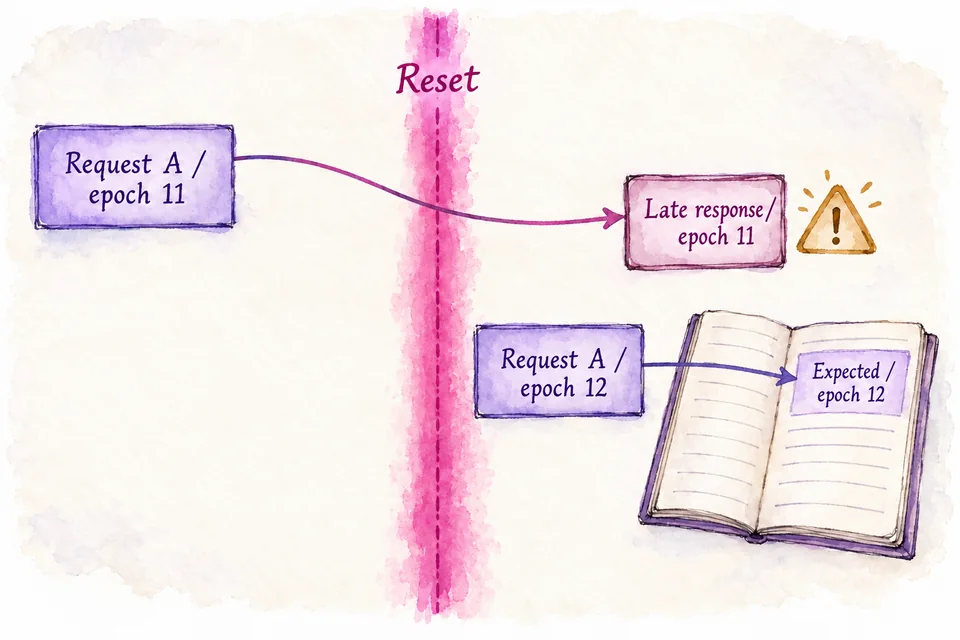
Request A is outstanding in epoch 11. Reset cancels old work; after the interface is ready, a new request reuses A in epoch 12. Now an old response arrives.
| Event | Identity | Expected result |
|---|---|---|
| Old request | (11, A) | Add an outstanding expectation. |
| Reset | Epoch 11 ends | Cancel old expectations under this contract. |
| New request | (12, A) | Track a new expectation after readiness. |
| Late response | (11, A) | Report stale work; keep (12, A) pending. |
expected = (epoch 12, ID A)
received = (epoch 11, ID A)
match = false → new request stays pending
Matching only ID A would incorrectly complete the new transaction. Follow the stale-response trace in the lab and check that the new expectation remains pending.
This fixture supplies epoch provenance. An untagged interface needs a real drain or cancellation contract before reusing IDs; a checker cannot infer an ambiguous response’s origin from its ID alone.
The reset boundary changes what is valid.
Track the expectation ledger as a domain resets, restarts, and receives a response from its previous lifetime.
Checkpoint 1 · Epoch 11 has accepted work.
- RESET
- 0
- EPOCH
- 11
- LEDGER
- 11:A
- RESPONSE
- —
Compare all 5 checkpoints
1 · Epoch 11 has accepted work.
- RESET
- 0
- EPOCH
- 11
- LEDGER
- 11:A
- RESPONSE
- —
2 · Reset cancels this domain’s work.
- RESET
- 1
- EPOCH
- 11
- LEDGER
- cancel
- RESPONSE
- —
3 · Clean up the matching expectations.
- RESET
- 1
- EPOCH
- 11
- LEDGER
- empty
- RESPONSE
- —
4 · Epoch 12 starts after readiness.
- RESET
- 0
- EPOCH
- 12
- LEDGER
- 12:A
- RESPONSE
- —
5 · New work completes in its own epoch.
- RESET
- 0
- EPOCH
- 12
- LEDGER
- empty
- RESPONSE
- 12:A
Epoch 11 has accepted work.
- Epoch
- 11
- Pending
- A
Transaction A is outstanding in the domain that will reset. The independent scoreboard carries its ID and epoch.
Preserve the accepted handshake and expectation identity.
Inspect the checker Selected checkpoint pseudocode
pending[{11, A}] = expected_A;Example contract & limitations
Example contract. The fixture provides epoch provenance. On an untagged interface, a real drain/cancellation contract is needed before reusing IDs. Only the reset domain is invalidated; sticky and unaffected-domain state follows its specification. Checkpoints show selected state changes, not equally spaced simulation cycles.
Read the complete walkthrough
Coordinated reset
- Epoch 11 has accepted work.. Transaction A is outstanding in the domain that will reset. The independent scoreboard carries its ID and epoch. Evidence: Preserve the accepted handshake and expectation identity.
- Reset cancels this domain’s work.. Stop new stimulus and drive the reset-safe interface state. The reset contract explicitly invalidates transaction A. Evidence: Check driver VALID, reset assertion, and the domain cancellation boundary.
- Clean up the matching expectations.. Flush invalidated expectations and resynchronize model and register abstraction state. Preserve state the specification marks sticky. Evidence: Verify no epoch-11 expectation remains eligible for a future response.
- Epoch 12 starts after readiness.. The domain finishes initialization. New transaction A can now be tracked with epoch-12 provenance. Evidence: Observe readiness before reopening stimulus.
- New work completes in its own epoch.. The response belongs to epoch 12 and matches the current expectation. Old work cannot consume it. Evidence: Correlate epoch, ID, and data before retiring the entry.
Late old-epoch response
- Epoch 11 has accepted work.. Transaction A is outstanding in the domain that will reset. The independent scoreboard carries its ID and epoch. Evidence: Preserve the accepted handshake and expectation identity.
- Reset cancels this domain’s work.. Stop new stimulus and drive the reset-safe interface state. The reset contract explicitly invalidates transaction A. Evidence: Check driver VALID, reset assertion, and the domain cancellation boundary.
- Clean up the matching expectations.. Flush invalidated expectations and resynchronize model and register abstraction state. Preserve state the specification marks sticky. Evidence: Verify no epoch-11 expectation remains eligible for a future response.
- Epoch 12 starts after readiness.. The domain finishes initialization. New transaction A can now be tracked with epoch-12 provenance. Evidence: Observe readiness before reopening stimulus.
- A stale response is a real failure.. A response with epoch-11 provenance arrives after restart. Report the violation and leave epoch-12 transaction A pending. Evidence: Retain the stale response and show that the new expectation was not consumed.
Related implementation: Coordinate scoreboard, sequencer, and RAL cleanup
function void mac_scoreboard::flush();
  exp_fifo.flush();
  actual_fifo.flush();
  m_expected_count = 0;
endfunction

task mac_env::run_phase(uvm_phase phase);
  forever begin
    @(negedge vif.rst_n);

    agt.sqr.stop_sequences();
    scb.flush();
    reg_model.reset();

    wait (vif.rst_n === 1'b1);
    uvm_report_info("ENV", "Reset released: resume", UVM_LOW);
  end
endtask
Cleanup follows the hardware state transition: stop producers, discard predictions that no longer exist, synchronize the register mirror, then wait for reset release.
Understand the failure+
A reset observer ends the old comparison epoch, cancels traffic, clears interfaces and models, then releases stimulus only after the DUT advertises readiness.
observed transaction epoch = active scoreboard epoch → eligible for comparison
Reset event fanout
One reset edge interrupts stimulus first, then reconciles checking and model state before traffic resumes.
- Reset edge
- Warm, IP, subsystem, or global reset asserts during traffic.
- Reset handler
- Broadcasts the event and owns cleanup ordering.
- Driver and sequencer
- Abort the handshake and kill requests that cannot complete.
- Scoreboard
- Flushes predictions and actual observations invalidated by reset.
- RAL mirror
- Applies the correct reset kind while preserving sticky fields.
- Restart gate
- Waits for release and initialization before stimulus resumes.
- Reset edge -> Reset handler
- Reset handler -> Driver and sequencer
- Reset handler -> Scoreboard
- Reset handler -> RAL mirror
- Driver and sequencer + Scoreboard + RAL mirror -> Restart gate
Why it matters
- Modern SoCs reset more than once at power-on. Warm resets, IP resets, and subsystem resets can occur while the rest of the chip remains live.
- A testbench that cannot recover from reset during traffic cannot verify high-availability or error-recovery behavior.
- Hardware clears registers and pipelines immediately, while software testbench objects preserve state until they are told what to discard, retain, or restart.
What is difficult
- A sequence can block forever waiting for a response that the reset erased.
- A scoreboard can retain pre-reset expected items and compare them against unrelated post-reset traffic.
- Reset scope is not always global. One agent may need to restart while unrelated interfaces continue running.
- UVM phase jumping requires every component and domain to move coherently, which is difficult to debug and scale across a large team.
Failure signatures
- A driver completes a stale handshake or leaves valid asserted across reset.
- A sequencer keeps requests that can no longer receive responses.
- Expected or actual queues leak across the reset boundary and create false mismatches.
- The RAL mirror retains pre-reset values even though hardware returned non-sticky fields to defaults.
- A DUT buffer fails to clear and releases old data after reset.
Compare approaches+
Two viable approaches—and their cost
UVM phase jumping
Force the UVM domain back to reset_phase so components reinitialize through standard phase callbacks.
- Uses the official UVM phase mechanism.
- Can coordinate component reinitialization through existing reset-phase code.
- Difficult to debug when only part of the environment jumps.
- Can deadlock when components or domains do not move together.
- Provides less granular control for an IP-only reset while other agents continue.
Centralized reset handler
Monitor reset as a dynamic sideband event and explicitly broadcast cleanup and restart work.
- Keeps reset behavior explicit and independent of the UVM phase controller.
- Can reset one agent or subsystem without disturbing unrelated traffic.
- Makes each component's flush, kill, preserve, and restart policy reviewable.
- Every stateful component needs a reset cleanup or recovery method.
- The environment must define ordering between aborting stimulus, flushing checks, and resetting mirrors.
Explain it in an interview+
Interview answer, built from the mechanism
- Treat reset as a dynamic event rather than a one-time phase. A dedicated reset handler detects the edge and tells every affected component what to do.
- Make the driver interruptible with fork-join_any so the reset watcher can abort a bus handshake immediately. Stop sequencer activity so no blocked request remains behind.
- Flush expected and actual scoreboard state that hardware discarded, and call the appropriate RAL reset type so the mirror matches hardware defaults while sticky state is preserved.
- Wait for reset release, perform any required reboot or initialization checks, and only then resume stimulus.
Assign responsibilities+
Component responsibility contract
| Component | Responsibility | Required change |
|---|---|---|
| Driver | Handshake abort | Wrap sequence-item driving and reset detection in fork-join_any. |
| Sequencer | Sequence kill | Call stop_sequences() to clear blocked and queued requests. |
| Scoreboard | Data flush | Clear expected and actual queues plus local counters and state machines. |
| RAL model | Mirror reset | Call the correct reg_model.reset() type to match hardware defaults. |
| Reset handler | Event ordering | Broadcast reset, coordinate cleanup, wait for release, and authorize restart. |
Build the checker+
Implementation patterns
task mac_driver::run_phase(uvm_phase phase);
  forever begin
    wait (vif.rst_n === 1'b1);

    fork
      begin : drive_process
        forever begin
          seq_item_port.get_next_item(req);
          drive_item(req);
          seq_item_port.item_done();
        end
      end

      begin : reset_watcher
        @(negedge vif.rst_n);
        uvm_report_info("DRV", "Reset detected: abort drive", UVM_LOW);
      end
    join_any

    disable fork;
    cleanup_signals();
  end
endtask

task mac_driver::cleanup_signals();
  vif.valid <= 1'b0;
  vif.data  <= 'z;
  // The reset handler kills the sequence, so this path does not call item_done().
endtask
The drive loop and reset watcher race. Reset wins immediately, disable fork removes stale drive activity, and the interface returns to an idle value before the next boot.
function void mac_scoreboard::flush();
  exp_fifo.flush();
  actual_fifo.flush();
  m_expected_count = 0;
endfunction

task mac_env::run_phase(uvm_phase phase);
  forever begin
    @(negedge vif.rst_n);

    agt.sqr.stop_sequences();
    scb.flush();
    reg_model.reset();

    wait (vif.rst_n === 1'b1);
    uvm_report_info("ENV", "Reset released: resume", UVM_LOW);
  end
endtask
Cleanup follows the hardware state transition: stop producers, discard predictions that no longer exist, synchronize the register mirror, then wait for reset release.
Stress the design+
Stress recipe
- Fill request queues, response queues, pipelines, and DUT buffers before asserting reset.
- Assert reset during an active valid-ready handshake and confirm the driver drops valid without hanging.
- Exercise warm, IP-level, subsystem, and full reset scopes while unrelated agents remain active.
- Verify sticky registers retain their value while non-sticky fields and the RAL mirror return to the correct reset type.
- Restart traffic immediately after the allowed reboot window and reject any pre-reset data.
Follow-up questions
How do you verify registers that are sticky and are not cleared by a warm reset?
Model distinct RAL reset kinds. On a warm reset, call model.reset("WARM") so only non-sticky fields return to their warm-reset defaults while sticky mirrors retain their values.
What happens to the sequence that reset interrupted?
Usually the environment kills it. If the use case requires a resumable sequence, checkpoint its progress in a configuration object before termination and restart from that state after reset recovery.
How do you expose a DUT buffer that fails to clear on reset?
Run a dirty-reset test: fill every buffer with traffic, assert reset while state is maximally dirty, then check immediately after release that no pre-reset payload leaks out.