
Q028FreeDesign Verification
Verify a RAM-based duplicate-ID detector
Question
Implement the shadow-memory oracle, completion audit, and core bus properties for a duplicate finder operating on software-programmed RAM containing N+1 values. N is positive; DW must represent N+1 and may exceed 32. Stored words and observed RAM images retain all DW bits. Program every address 0 through N with a known value before the first START. Legal input has exactly one distinct repeated value; controlled higher multiplicity may omit other legal values, but two distinct repeated values are out of contract. Any zero or value above N takes data_error precedence. Call accepted_write only for an accepted idle write and snapshot_start only for an accepted idle START. A read accepted at C first presents its response at C+1; a previous read may retire on the same edge as a new read or write. Busy blocks all configuration acceptance. The supplied protocol module uses sampled rising-edge reset for control state; retained RAM and shadow contents are an environment policy, not cleared by an oracle reset method.
Implementation scaffold
class duplicate_ram_oracle #(int N = 15, int DW = $clog2(64'(N)+2));
  typedef logic[DW-1:0] word_t;
  typedef word_t image_t[0:N];
  image_t mirror, start_image;
  function new();
    if(N<1 || DW<$clog2(64'(N)+2))
      $fatal(1,"N must be positive and DW must represent N+1");
  endfunction

  function void accepted_write(int unsigned addr, word_t data);
  // TODO: Implement this oracle or scoreboard method.
endfunction

  function void snapshot_start();
  // TODO: Implement this oracle or scoreboard method.
endfunction

  function void predict(output bit data_error,
                        output int unsigned duplicate_id);
  // TODO: Implement this oracle or scoreboard method.
endfunction

  function bit memory_unchanged(input image_t observed_after);
  // TODO: Implement this oracle or scoreboard method.
endfunction

  function void check_completion(
      input logic got_data_error,
      input word_t got_duplicate_id,
      input image_t observed_after);
  // TODO: Implement this oracle or scoreboard method.
endfunction
endclass

module duplicate_ram_protocol_checker #(int DW=5)(
 input logic clk,rst_n,cfg_valid,cfg_ready,cfg_write,
 input logic cfg_rsp_valid,cfg_rsp_ready,busy,done,
 input logic[DW-1:0]cfg_rdata
);
bit read_pending;
always @(posedge clk) begin : sample_config_transactions
  // TODO: Track reset and accepted transactions; compare/retire old responses first.
end
property p_cfg_response_hold;
  // TODO: Implement this named temporal obligation.
endproperty
property p_done_is_a_pulse;
  // TODO: Implement this named temporal obligation.
endproperty
property p_no_cfg_accept_while_busy;
  // TODO: Implement this named temporal obligation.
endproperty
property p_reset_cancels_read;
  // TODO: Implement this named temporal obligation.
endproperty
assert_cfg_response_hold:assert property(p_cfg_response_hold);
assert_done_is_a_pulse:assert property(p_done_is_a_pulse);
assert_no_cfg_accept_while_busy:assert property(p_no_cfg_accept_while_busy);
assert_reset_cancels_read:assert property(p_reset_cancels_read);
final begin : check_unfinished_config_read
  // TODO: Reject incomplete outstanding work at test end.
end
endmodule

// TODO: Describe legal shuffled/higher-multiplicity images and the reset-retained RAM/shadow policy.Trace one case
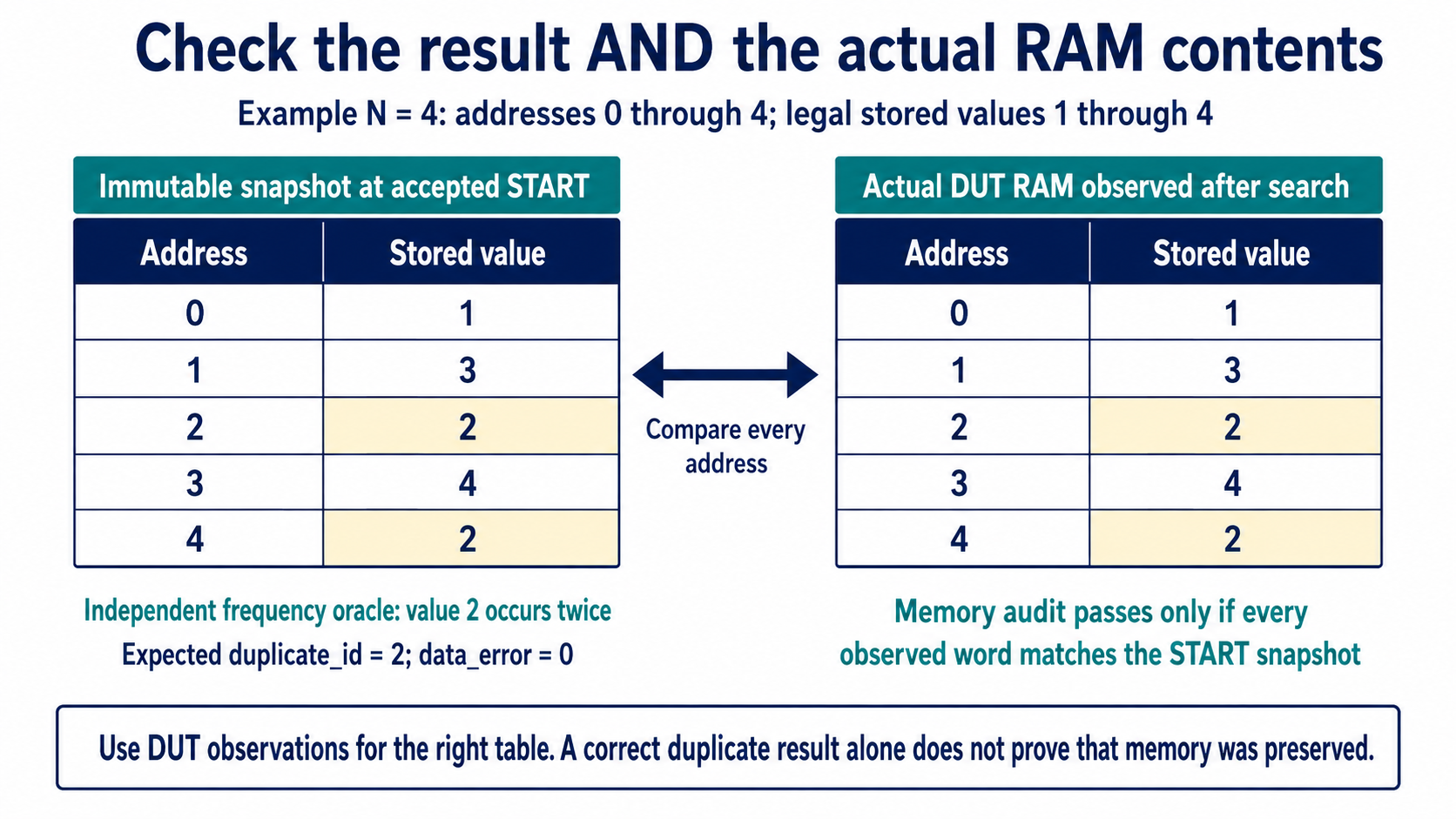
N=4; programmed RAM image = [1, 2, 3, 2, 4]; then repeat with [1, 0, 3, 2, 4]first run: duplicate_id=2, data_error=0; second run: duplicate_id=0, data_error=1The first snapshot contains one legal repeated ID, while zero is outside the allowed 1..N data range and takes the error path.
Requirements
- Model addresses 0 through N. Update the Register Abstraction Layer (RAL) shadow only for accepted configuration writes. Reads respond one cycle later and hold until consumed.
- Use legal shuffled images containing values 1 through N plus one repeated value, including controlled higher multiplicity.
- Use a frequency oracle and classify zero or any representable value above N as data_error with duplicate_id zero.
- Snapshot memory at accepted start, compare the functional result, and compare an observed post-search image with that snapshot.
- Assert read timing, response hold, done pulse shape, and blocked configuration while busy; discuss reset-retained memory as a follow-up environment rule.