
Q179FreeDesign Verification
Expire memory expectations without full scans
Question
Replace the full pending-memory scan with an ordered expiration queue while preserving per-address matching. Use a fixed positive 32-bit timeout. Callbacks are serialized: record expected writes and process all DUT observations for a cycle, then call tick() exactly once to advance one cycle and expire ages at least timeout. The total number of error reports in one checker lifetime is at most 2^31 - 1. At any time, the checker can retain at most 2,147,483,647 expectation objects in total, including matched objects still awaiting expiration. Count each object once even when both indexes reference it. The caller must stay within this storage limit before admitting another golden_write. The DUT does not need to report storage overflow.
Implementation scaffold
class expected_txn;
  longint addr;
  int data;
  int unsigned born;
  bit matched = 0;

  function new(longint addr, int data, int unsigned born);
    this.addr = addr;
    this.data = data;
    this.born = born;
  endfunction
endclass

class DeadlineMemoryChecker;
  expected_txn by_addr[longint][$];
  expected_txn deadlines[$];
  int unsigned cycle = 0;
  local int unsigned timeout;
  int errors = 0;

  function new(int unsigned timeout = 100);
    if (timeout == 0) $fatal(1, "timeout must be positive");
    this.timeout = timeout;
  endfunction

  function void golden_write(longint addr, int data);
    expected_txn t = new(addr, data, cycle);
    // Implement here: golden_write.
  endfunction

  function void dut_write(longint addr, int data);
    // Implement here: dut_write.
  endfunction

  function void tick();
    // Implement here: tick.
  endfunction

  function int error_count(); return errors; endfunction

  function void end_of_test_check();
    // Implement here: end_of_test_check.
  endfunction
endclassTrace one case
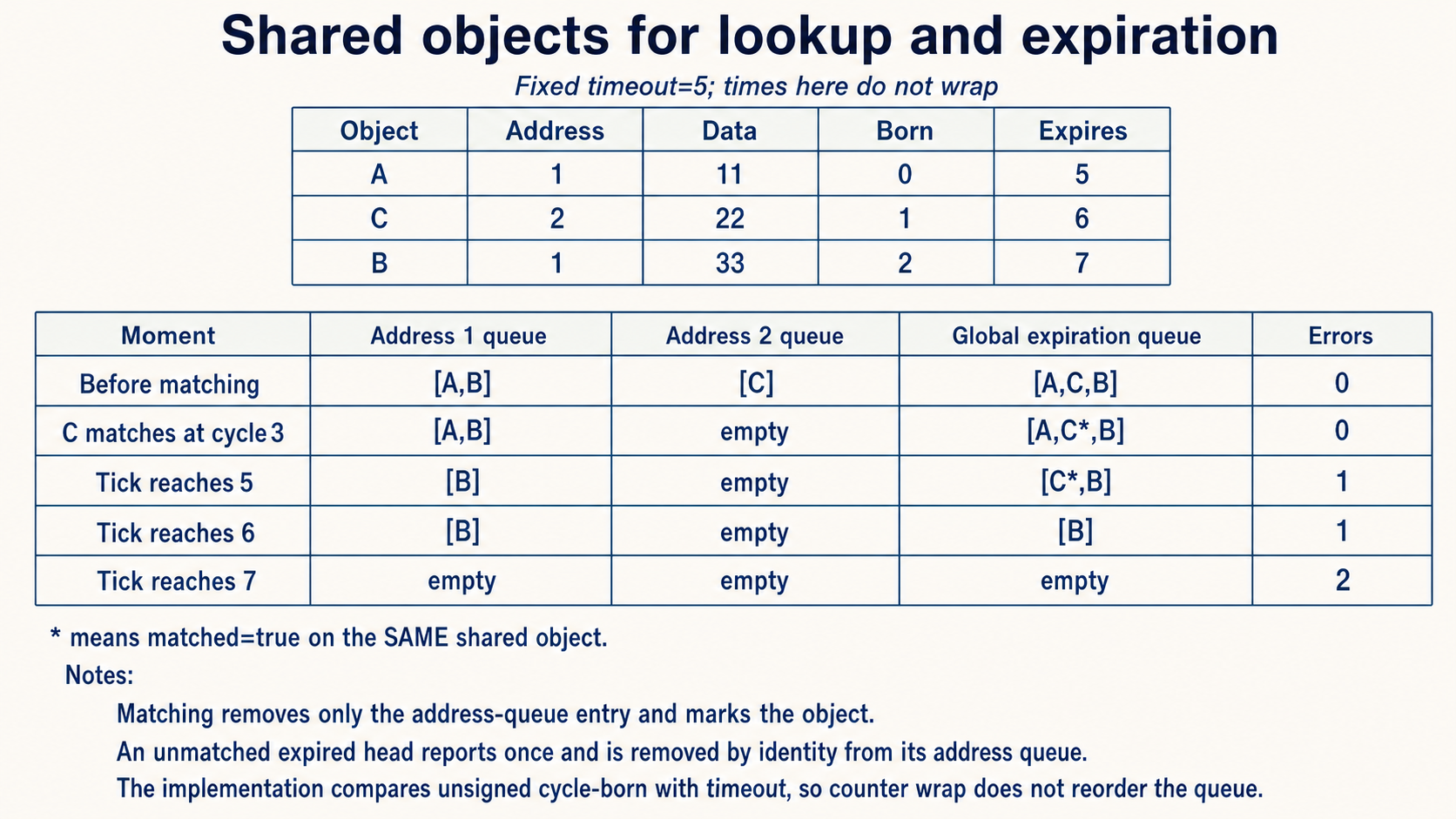
timeout=5; expect A at cycle 0 and B at cycle 2; match B at cycle 3; tick through cycles 5 and 7A adds one timeout report at cycle 5. B adds none when its marked entry retires at cycle 7.Both lookup structures contain the same objects. The matched flag is visible to expiration without searching for B in the global queue.
Requirements
- Store the same transaction object in the per-address queue and the expiration queue.
- Match one address/data expectation per DUT write. Mark its object so it can be skipped when it reaches expiration.
- Examine only expired objects at the expiration queue head; do not scan unrelated addresses each tick.
- Use a fixed timeout and insert expectations in call order. Unsigned age subtraction must work across the 32-bit cycle-counter wrap.
- Count unexpected DUT writes, unmatched expirations, and unmatched entries at end of test. Finalization clears both structures and must not report already matched or expired entries again.