
Q078FreeSystemVerilog
Report the top-K opcode frequencies
Interview prompt
Question
Count the opcode IDs in a completed packet frame and emit up to K distinct opcodes in descending frequency order, breaking equal counts by lower opcode ID. Supply a nonempty frame of at most 64 opcodes and assert in_last only on its final accepted input. Capture k from 1 through 4 with the first accepted opcode; later changes to k do not affect that frame.
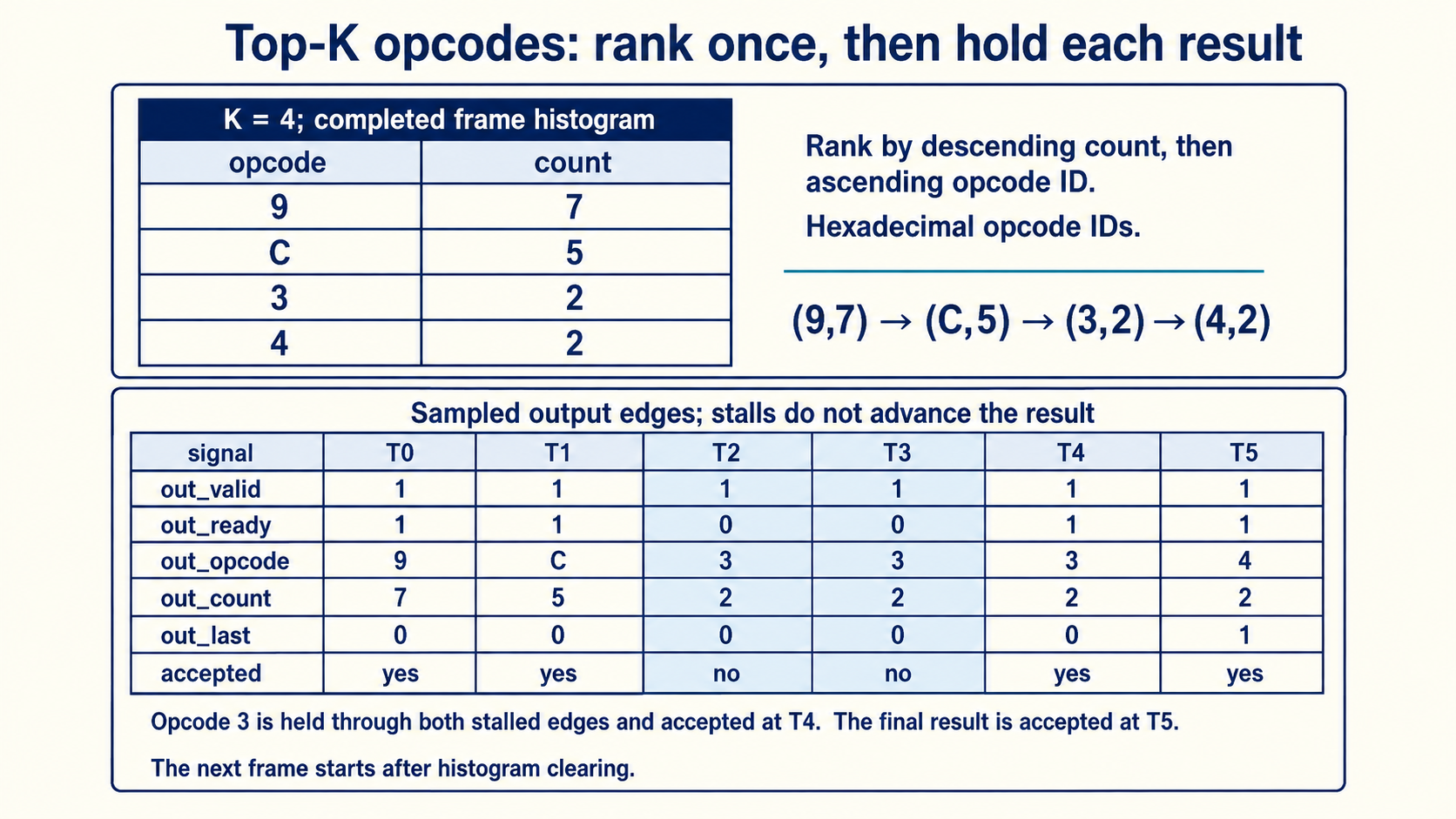
Candidate starting point
Implementation scaffold
module top_k_opcode_reporter (
  input  logic       clk,
  input  logic       rst_n,
  input  logic       in_valid,
  input  logic       in_last,
  input  logic [3:0] opcode,
  input  logic [2:0] k,
  input  logic       out_ready,
  output logic       in_ready,
  output logic       out_valid,
  output logic       out_last,
  output logic [3:0] out_opcode,
  output logic [6:0] out_count
);
  typedef enum logic [1:0] {S_CLEAR, S_INPUT, S_SELECT, S_OUTPUT} state_t;
  state_t state_q;

  logic [6:0] histogram_q [0:15];
  logic [3:0] clear_q;
  logic [6:0] frame_count_q;
  logic [2:0] k_q, rank_q, output_length_q, output_index_q;
  logic [15:0] selected_q;
  logic [3:0] result_opcode_q [0:3];
  logic [6:0] result_count_q [0:3];

  logic candidate_found;
  logic [3:0] candidate_opcode;
  logic [6:0] candidate_count;

  always_comb begin : select_next_opcode
    // TODO: Implement select_next_opcode using the supplied state and interface.
  end

  assign in_ready   = (state_q == S_INPUT);
  assign out_valid  = (state_q == S_OUTPUT);
  assign out_opcode = result_opcode_q[output_index_q];
  assign out_count  = result_count_q[output_index_q];
  assign out_last   = (state_q == S_OUTPUT) &&
                      (output_index_q + 1'b1 == output_length_q);

  always_ff @(posedge clk) begin : clear_count_select_and_drain
    // TODO: Implement clear_count_select_and_drain using the supplied state and interface.
  end
endmodule
Reviewed example
Trace one case
Input
accepted opcodes = [3, 1, 3, 2, 1, 3]; K=2Expected output
ranked outputs = [(opcode=3,count=3), (opcode=1,count=2)]Opcode 3 appears most often, followed by opcode 1. Each is emitted once with its count.
What to cover
Requirements
- Support opcode IDs 0 to 15, frame lengths from 1 to 64, and K from 1 to 4 captured with the first item.
- Clear or invalidate all 16 histogram bins between frames.
- Do not select an opcode twice and never emit an absent opcode.
- If fewer than K distinct opcodes appear, emit only those present.
- Begin ranking only after the frame is complete and hold each output token stable while stalled.