
Q089FreeFirmware
Parse a bounded Roman board revision
Interview prompt
Question
Parse an explicitly sized EEPROM field as a canonical Roman numeral from I through MMMCMXCIX without allocation or out-of-range reads. The field length is 1..15 bytes. Length 0 or greater than 15 is an invalid argument and is rejected before parsing, even if its bytes would otherwise sum above 3999. Nonnull pointers denote valid live storage for the stated input extent and a separate writable uint16_t output object.
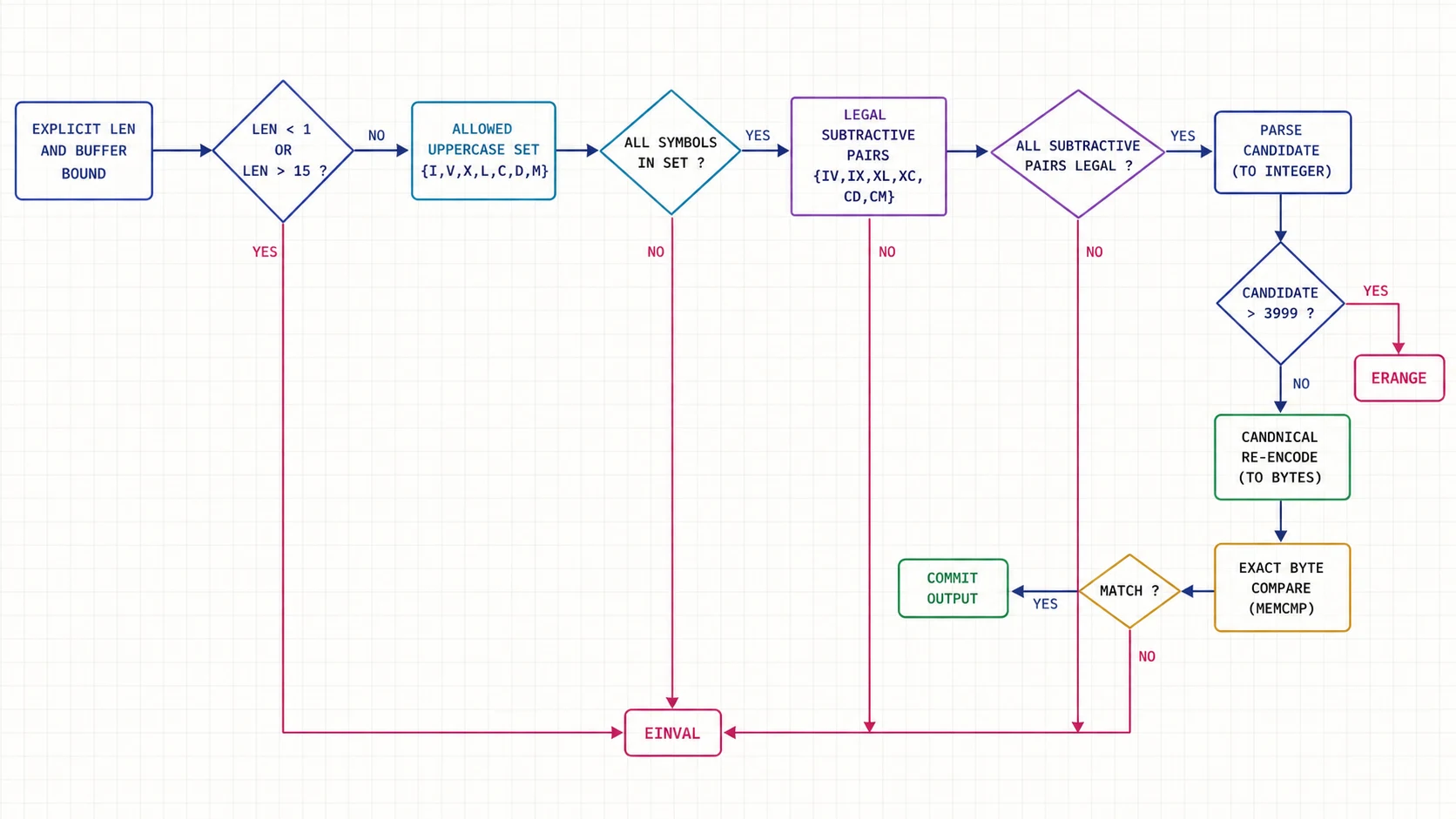
Candidate starting point
Implementation scaffold
#include <stdbool.h>
#include <stddef.h>
#include <stdint.h>

typedef enum { ROMAN_OK, ROMAN_EINVAL, ROMAN_ERANGE } roman_rc_t;

static int roman_digit(uint8_t c) {
  switch (c) {
    case 'I': return 1; case 'V': return 5; case 'X': return 10;
    case 'L': return 50; case 'C': return 100; case 'D': return 500;
    case 'M': return 1000; default: return -1;
  }
}

static bool roman_pair(uint8_t a, uint8_t b) {
  return (a == 'I' && (b == 'V' || b == 'X')) ||
         (a == 'X' && (b == 'L' || b == 'C')) ||
         (a == 'C' && (b == 'D' || b == 'M'));
}

static bool roman_is_canonical(const uint8_t *buf, size_t len,
                               uint16_t value) {
  static const uint16_t values[] =
      {1000,900,500,400,100,90,50,40,10,9,5,4,1};
  static const char *const tokens[] =
      {"M","CM","D","CD","C","XC","L","XL","X","IX","V","IV","I"};
  // Implement here: compare the greedy encoding against exactly len bytes.

}

roman_rc_t roman_to_u16(const uint8_t *buf, size_t len, uint16_t *value) {
  // Implement here: validate bounded input, parse pairs, enforce range/canonical form,
  // then write the caller output only on complete success.
}
Reviewed example
Trace one case
Input
bytes="MCMXCIV", length=7Expected output
success; revision=1994The subtractive pairs CM, XC, and IV are legal, and re-encoding 1994 reproduces the exact input, confirming its canonical spelling.
What to cover
Requirements
- Accept only uppercase I, V, X, L, C, D, and M and the six standard subtractive pairs.
- Before reading input, reject null buffer/output pointers or lengths outside 1..15 with ROMAN_EINVAL. Within that length bound, invalid symbols or subtractive pairs take precedence. After all bytes parse, return ROMAN_ERANGE if the total is above 3999, before checking canonical spelling.
- Reject noncanonical spellings by re-encoding the parsed value and comparing every input byte.
- Do not call strlen or modify the caller's output until the complete parse succeeds.